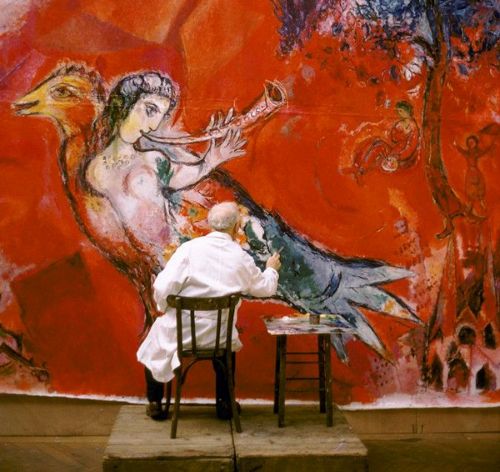
Marc Chagall (1887-1985) was a Russian and French artist whose vibrant works blended Cubism, Symbolism, and Fauvism with deeply personal themes. His style often featured floating figures, fantastical animals, and recurring motifs. Chagall’s extensive oeuvre includes paintings, stained glass, stage sets, and tapestries.
Marc Chagall’s angel-themed paintings are a poetic blend of mysticism, memory, and vibrant imagination. His angels are not traditional in the classical or religious sense; they are often symbolic and deeply integrated into the narrative of the artwork.
His work, characterized by its emotional intensity and brilliant color, makes him one of the most beloved artists of the 20th century.
_______________________________________________________
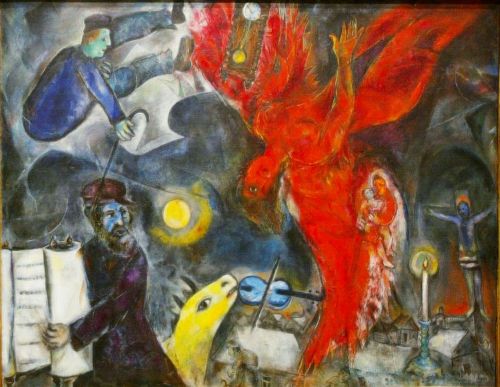
“The Falling Angel” (1923–1947)
Marc Chagall’s The Falling Angel is a striking image of chaos and sorrow. It features a glowing red angel falling, possibly from grace, amidst a chaotic scene that combines Jewish and Christian motifs, reflecting the turmoil and displacement of the 20th century. A deeply symbolic piece that took nearly 25 years to complete.
_______________________________________________________
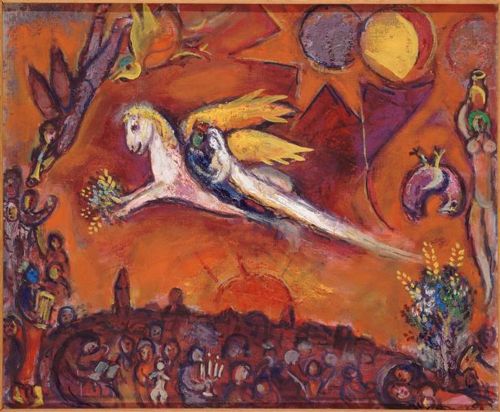
“Song of Songs IV” (1958)
Marc Chagall’s Song of Songs IV is a surreal interpretation of the biblical love poem. The vibrant colors and fantastical elements convey an otherworldly passion. Part of a larger series illustrating the Old Testament, it embodies love, desire, and the mystical, lyrical essence of the Song of Songs.
_______________________________________________________
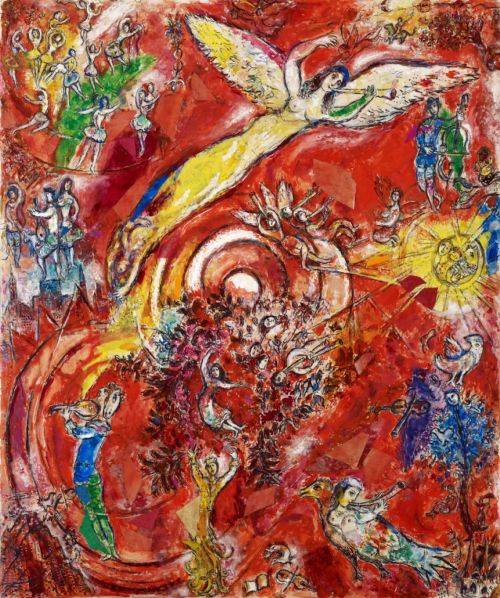
“The Triumph of Music” (1966)
Marc Chagall’s The Triumph of Music celebrates music’s transformative power. The large-scale mural, originally for the Metropolitan Opera, shows how Chagall’s poetic vision transforms sound into visual symphony. Here, the angels seem to evoke art as divine expression.
______________________________________________________


Leave a Reply